Blog

YOLOv8 Segmentation Masks and Output Format Explained

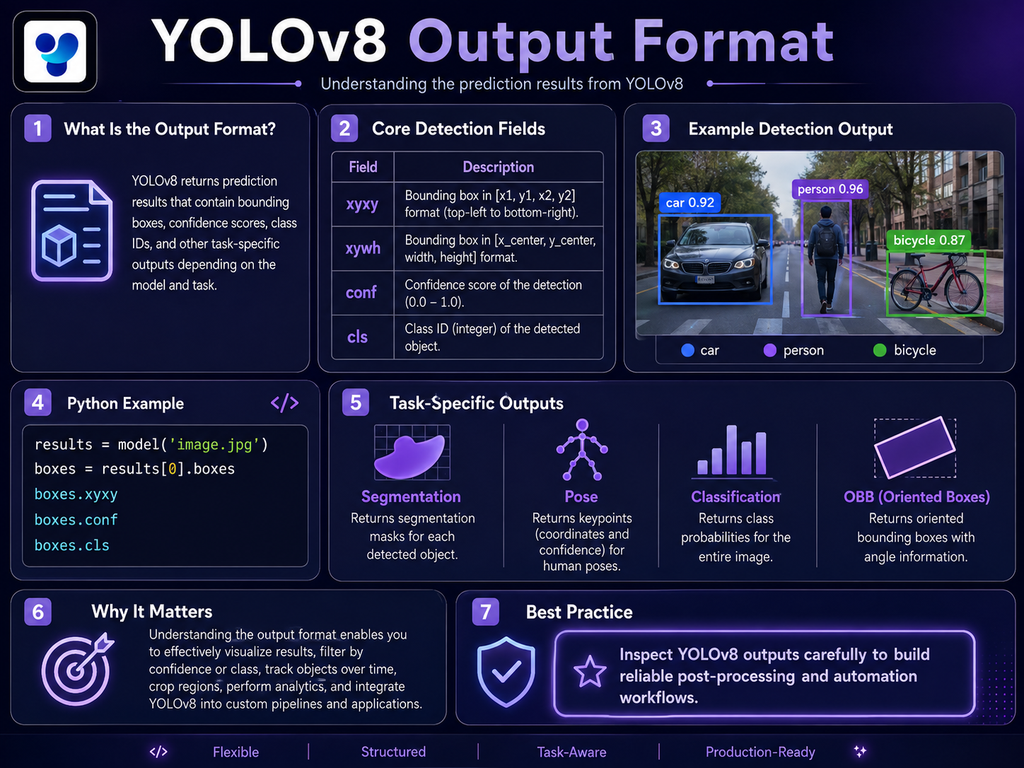
YOLOv8 segmentation masks describe the pixel-level shape of each detected object rather than representing it only with a rectangular bounding box. A YOLOv8 segmentation result can include bounding boxes, class IDs, confidence scores, binary or probability-based mask data, and polygon coordinates for each detected instance. In the Ultralytics Python API, segmentation information is exposed through […]

YOLOv8 Segmentation Masks and Output Format Explained Read More »

YOLOv8 Segmentation Label Format: Complete Annotation Guide

The YOLOv8 segmentation label format represents each object with a class ID followed by a sequence of normalized polygon coordinates. Unlike normal object detection labels, segmentation labels do not describe an object only with a rectangular bounding box. Instead, multiple (x, y) points trace the object’s shape, allowing YOLOv8 segmentation models to learn pixel-level object

YOLOv8 Segmentation Label Format: Complete Annotation Guide Read More »

YOLOv8 Pose Keypoints and Output Format Explained

YOLOv8 Pose keypoints represent important landmark positions on detected objects, such as the nose, shoulders, elbows, wrists, hips, knees, and ankles in human pose estimation. A YOLOv8 Pose prediction can include bounding boxes, class information, detection confidence, keypoint coordinates, and keypoint confidence values. Understanding this output format is important when building pose tracking, sports analysis,

YOLOv8 Pose Keypoints and Output Format Explained Read More »

YOLOv8 Hand Pose Estimation: Detection, Keypoints, and Custom Training

YOLOv8 hand pose estimation uses pose/keypoint detection to locate hands and predict landmark positions representing the wrist, fingers, and individual finger joints. YOLOv8 supports pose training and inference, so it can be fine-tuned on a hand-keypoint dataset for applications such as gesture recognition, sign-language systems, human-computer interaction, robotics, and AR/VR. A common hand landmark structure

YOLOv8 Hand Pose Estimation: Detection, Keypoints, and Custom Training Read More »

YOLOv8 Pose Dataset Format: Complete Guide for Custom Training

The YOLOv8 Pose dataset format extends the standard YOLO object detection format by adding keypoint coordinates to each labeled object. Every training image has a corresponding text label file containing the class ID, normalized bounding box coordinates, and the defined keypoints. Depending on the dataset configuration, each keypoint can contain either x, y coordinates or

YOLOv8 Pose Dataset Format: Complete Guide for Custom Training Read More »

YOLOv8 COCO Class List: Complete 80 Object Categories

The YOLOv8 COCO class list contains 80 object categories that pretrained YOLOv8 detection models can recognize. These classes come from the COCO dataset and include common objects such as people, cars, animals, furniture, food items, sports equipment, and household objects. Each class has a unique ID from 0 to 79, which YOLOv8 uses internally during

YOLOv8 COCO Class List: Complete 80 Object Categories Read More »

YOLOv8 Release Notes and Updates: Features, Changes, and Improvements

YOLOv8 release notes and updates document the changes made to the Ultralytics package that supports YOLOv8 and other Ultralytics YOLO models. Since YOLOv8 was introduced on January 10, 2023, the surrounding Ultralytics software has received frequent updates covering training, prediction, export, deployment, bug fixes, compatibility, and performance. YOLOv8 remains supported inside the modern Ultralytics framework

YOLOv8 Release Notes and Updates: Features, Changes, and Improvements Read More »

YOLOv8 CSPDarknet Backbone: Architecture, Working, and Features

The YOLOv8 CSPDarknet backbone is responsible for extracting meaningful visual features from input images before those features are passed to the neck and detection head. Its design builds on CSP-style feature extraction principles while using C2f modules to improve gradient flow, feature reuse, and computational efficiency. This backbone helps YOLOv8 identify useful patterns at different

YOLOv8 CSPDarknet Backbone: Architecture, Working, and Features Read More »

How to Export YOLOv8 to ONNX Format

Exporting YOLOv8 to ONNX format allows a trained Ultralytics model to run outside the normal PyTorch environment. ONNX, or Open Neural Network Exchange, provides a standardized model representation supported by runtimes and deployment tools such as ONNX Runtime, OpenCV DNN, TensorRT conversion pipelines, and other inference systems. Ultralytics provides built-in ONNX export through both the

How to Export YOLOv8 to ONNX Format Read More »

Scroll to Top