
Author name: Jane Torres

I'm Jane Austen, a skilled content writer with the ability to simplify any complex topic. I focus on delivering valuable tips and strategies throughout my articles.

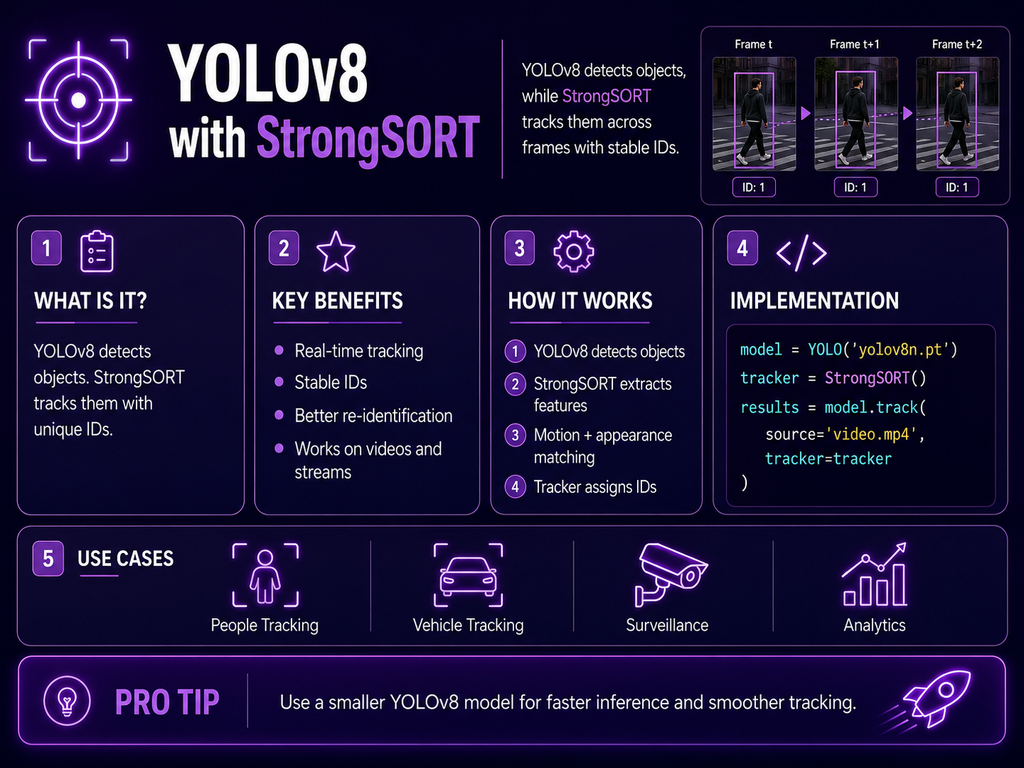
YOLOv8 with StrongSORT: Real-Time Object Detection and Tracking

YOLOv8 with StrongSORT combines YOLOv8 object detection with an appearance-aware multi-object tracker that can maintain identities across video frames. YOLOv8 detects objects and provides bounding boxes, classes, and confidence scores, while StrongSORT associates those detections over time using motion information and deep appearance features. StrongSORT was developed as an improved version of DeepSORT, with changes […]

YOLOv8 with StrongSORT: Real-Time Object Detection and Tracking Read More »

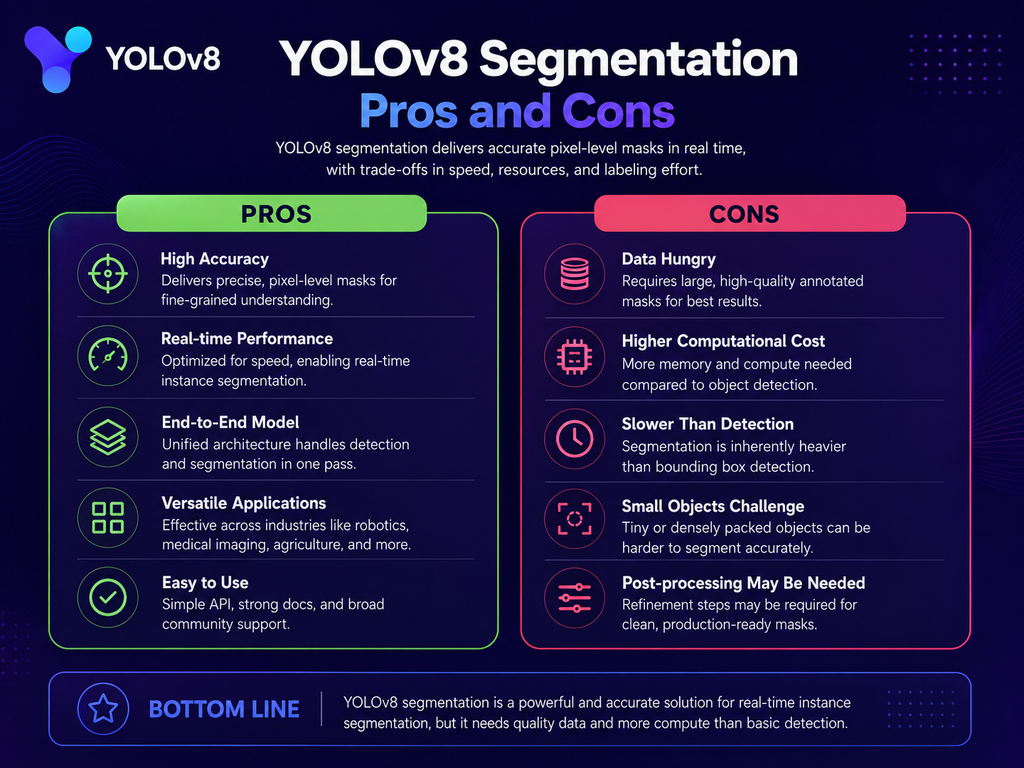
YOLOv8 Segmentation Pros and Cons: Advantages, Limitations, and Use Cases

YOLOv8 segmentation combines object detection with pixel-level instance masks, allowing the model to identify both where an object is located and which pixels belong to it. Its main advantages include fast inference, support for multiple classes, custom dataset training, and practical deployment options. However, segmentation also requires more computation, more detailed annotations, and more memory

YOLOv8 Segmentation Pros and Cons: Advantages, Limitations, and Use Cases Read More »

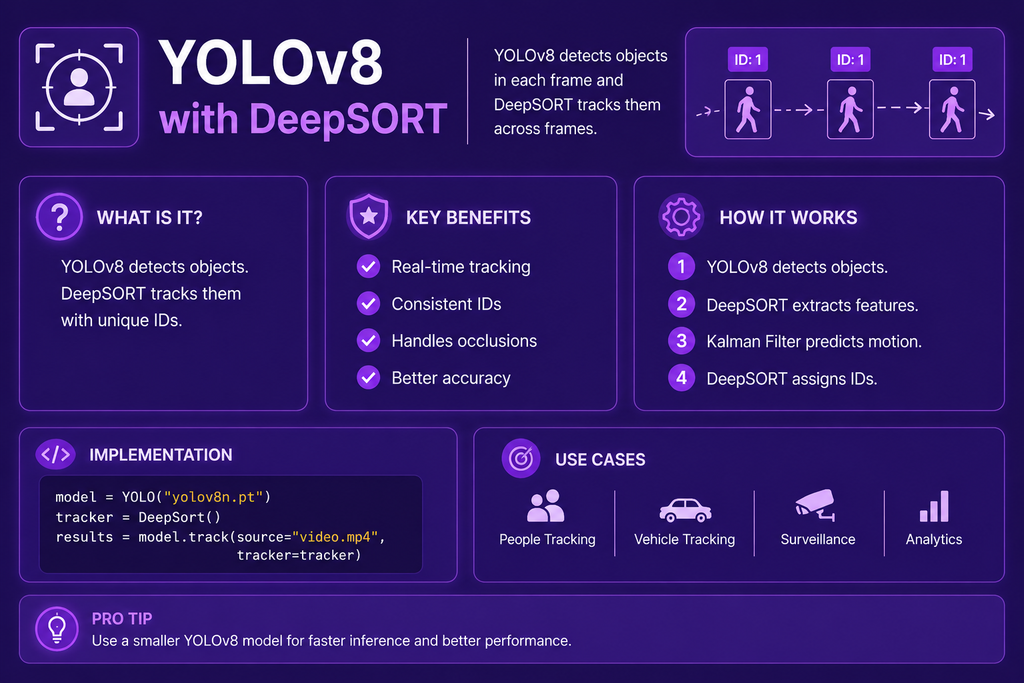
YOLOv8 with DeepSORT: Real-Time Object Detection and Tracking

YOLOv8 with DeepSORT combines fast object detection with multi-object tracking. YOLOv8 detects objects in each video frame, while DeepSORT links those detections across frames and assigns persistent tracking IDs. DeepSORT extends SORT by adding deep appearance features, which helps reduce identity switches and improves tracking through short occlusions. Ultralytics itself currently ships trackers such as

YOLOv8 with DeepSORT: Real-Time Object Detection and Tracking Read More »

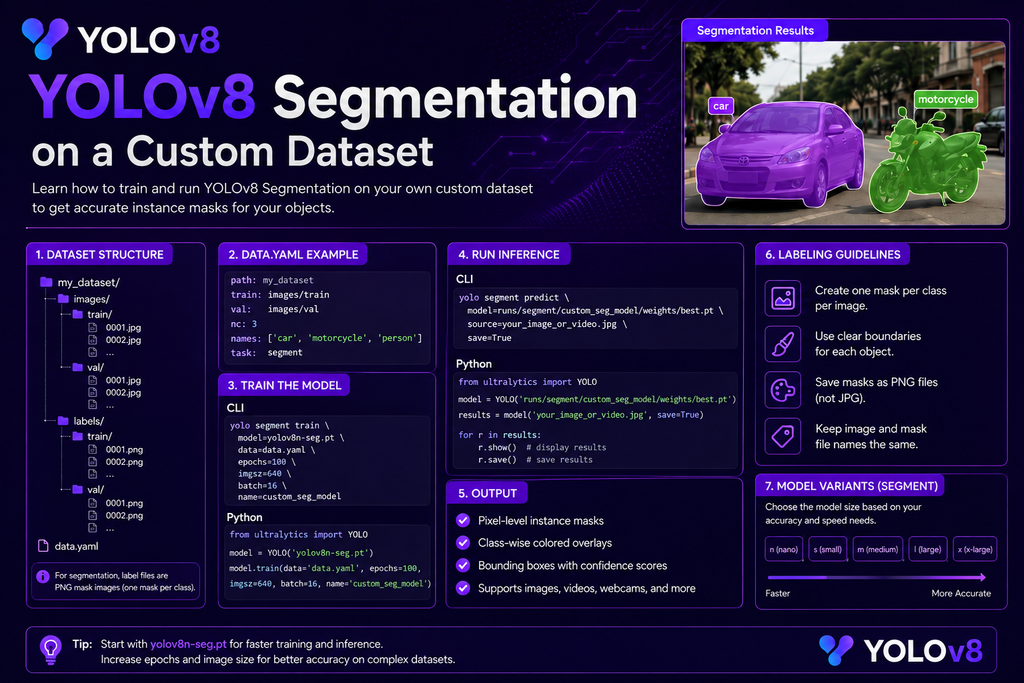
How to Train YOLOv8 Segmentation on a Custom Dataset

Training YOLOv8 segmentation on a custom dataset allows you to detect objects and generate pixel-level masks that describe their exact shapes. Unlike standard object detection, which predicts rectangular bounding boxes, YOLOv8 instance segmentation predicts a separate mask for each detected object. The YOLOv8 family includes dedicated segmentation checkpoints such as yolov8n-seg.pt, yolov8s-seg.pt, yolov8m-seg.pt, yolov8l-seg.pt, and

How to Train YOLOv8 Segmentation on a Custom Dataset Read More »

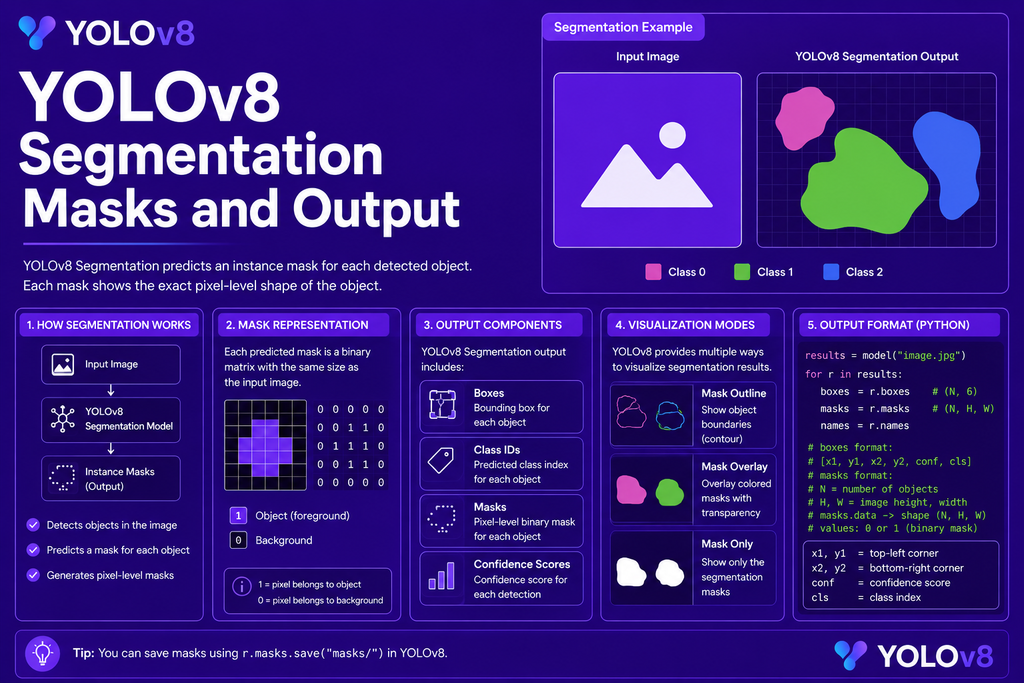
YOLOv8 Segmentation Masks and Output Format Explained

YOLOv8 segmentation masks describe the pixel-level shape of each detected object rather than representing it only with a rectangular bounding box. A YOLOv8 segmentation result can include bounding boxes, class IDs, confidence scores, binary or probability-based mask data, and polygon coordinates for each detected instance. In the Ultralytics Python API, segmentation information is exposed through

YOLOv8 Segmentation Masks and Output Format Explained Read More »

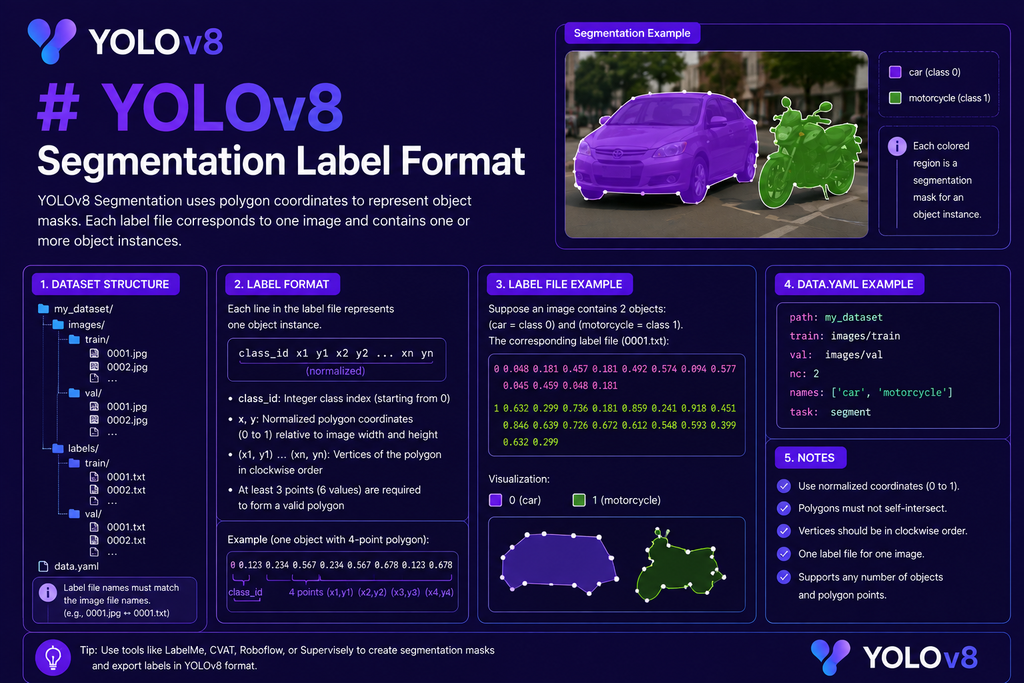
YOLOv8 Segmentation Label Format: Complete Annotation Guide

The YOLOv8 segmentation label format represents each object with a class ID followed by a sequence of normalized polygon coordinates. Unlike normal object detection labels, segmentation labels do not describe an object only with a rectangular bounding box. Instead, multiple (x, y) points trace the object’s shape, allowing YOLOv8 segmentation models to learn pixel-level object

YOLOv8 Segmentation Label Format: Complete Annotation Guide Read More »

YOLOv8 Pose Keypoints and Output Format Explained

YOLOv8 Pose keypoints represent important landmark positions on detected objects, such as the nose, shoulders, elbows, wrists, hips, knees, and ankles in human pose estimation. A YOLOv8 Pose prediction can include bounding boxes, class information, detection confidence, keypoint coordinates, and keypoint confidence values. Understanding this output format is important when building pose tracking, sports analysis,

YOLOv8 Pose Keypoints and Output Format Explained Read More »

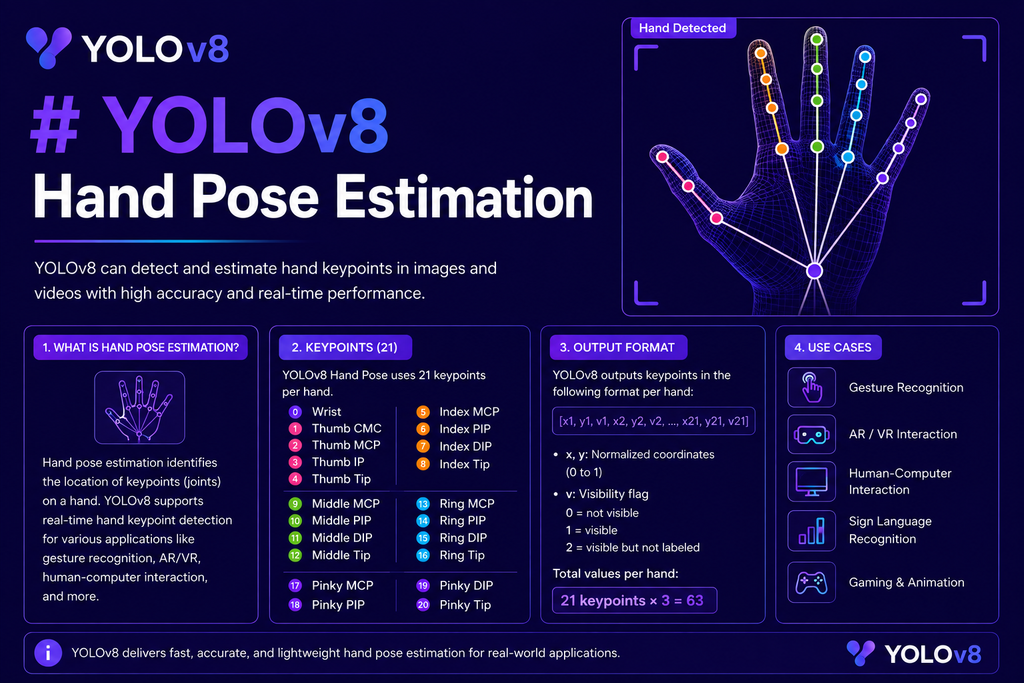
YOLOv8 Hand Pose Estimation: Detection, Keypoints, and Custom Training

YOLOv8 hand pose estimation uses pose/keypoint detection to locate hands and predict landmark positions representing the wrist, fingers, and individual finger joints. YOLOv8 supports pose training and inference, so it can be fine-tuned on a hand-keypoint dataset for applications such as gesture recognition, sign-language systems, human-computer interaction, robotics, and AR/VR. A common hand landmark structure

YOLOv8 Hand Pose Estimation: Detection, Keypoints, and Custom Training Read More »

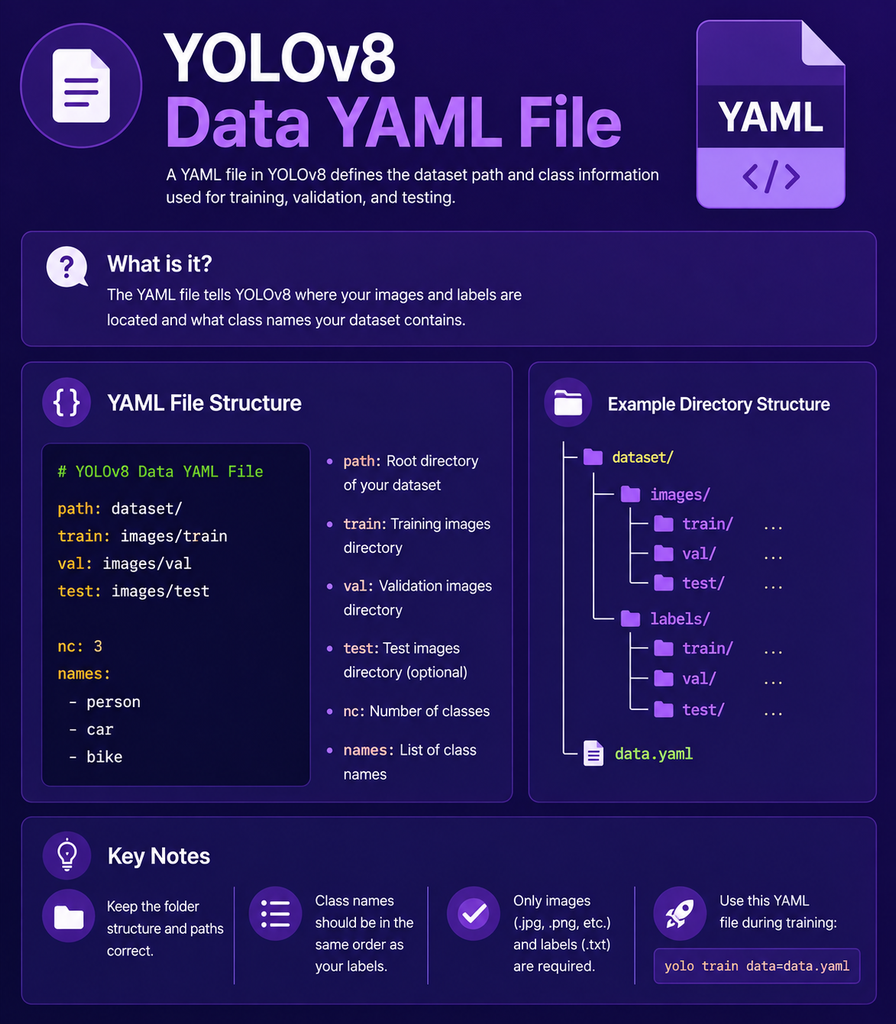
YOLOv8 Pose Dataset Format: Complete Guide for Custom Training

The YOLOv8 Pose dataset format extends the standard YOLO object detection format by adding keypoint coordinates to each labeled object. Every training image has a corresponding text label file containing the class ID, normalized bounding box coordinates, and the defined keypoints. Depending on the dataset configuration, each keypoint can contain either x, y coordinates or

YOLOv8 Pose Dataset Format: Complete Guide for Custom Training Read More »

Scroll to Top