
Author name: Jane Torres

I'm Jane Austen, a skilled content writer with the ability to simplify any complex topic. I focus on delivering valuable tips and strategies throughout my articles.

How to Export YOLOv8 to ONNX Format

Exporting YOLOv8 to ONNX format allows a trained Ultralytics model to run outside the normal PyTorch environment. ONNX, or Open Neural Network Exchange, provides a standardized model representation supported by runtimes and deployment tools such as ONNX Runtime, OpenCV DNN, TensorRT conversion pipelines, and other inference systems. Ultralytics provides built-in ONNX export through both the […]

How to Export YOLOv8 to ONNX Format Read More »

YOLOv8 Non-Maximum Suppression: How NMS Works in Object Detection

YOLOv8 Non-Maximum Suppression, or NMS, is a post-processing step used to remove redundant overlapping bounding boxes from object detection predictions. A detector may initially produce several boxes around the same object. NMS compares their confidence scores and overlap, keeps the strongest detection, and suppresses weaker overlapping boxes. Current Ultralytics prediction settings expose parameters such as

YOLOv8 Non-Maximum Suppression: How NMS Works in Object Detection Read More »

YOLOv8 IoU Threshold: How It Works and How to Choose the Right Value

The YOLOv8 IoU threshold controls how strongly overlapping bounding boxes are treated during prediction post-processing and validation. IoU, or Intersection over Union, measures the amount of overlap between two bounding boxes. In Ultralytics prediction mode, the iou argument is primarily used as the IoU threshold for Non-Maximum Suppression, where overlapping predictions are filtered to reduce

YOLOv8 IoU Threshold: How It Works and How to Choose the Right Value Read More »

YOLOv8 Task Aligned Assigner: Working, Architecture, and Benefits

The YOLOv8 Task Aligned Assigner is a training component used to match model predictions with ground-truth objects. It helps determine which prediction points should be treated as positive samples during training by considering both classification confidence and localization quality. This improves the alignment between object classification and bounding box prediction, allowing YOLOv8 to learn more

YOLOv8 Task Aligned Assigner: Working, Architecture, and Benefits Read More »

YOLOv8 SPPF Module: Architecture, Working, and Benefits

The YOLOv8 SPPF module is an important part of the backbone that helps the model capture information from a wider spatial area without adding heavy computational cost. SPPF stands for Spatial Pyramid Pooling Fast. It uses repeated max-pooling operations and feature concatenation to collect multi-scale contextual information before passing the processed features to later stages

YOLOv8 SPPF Module: Architecture, Working, and Benefits Read More »

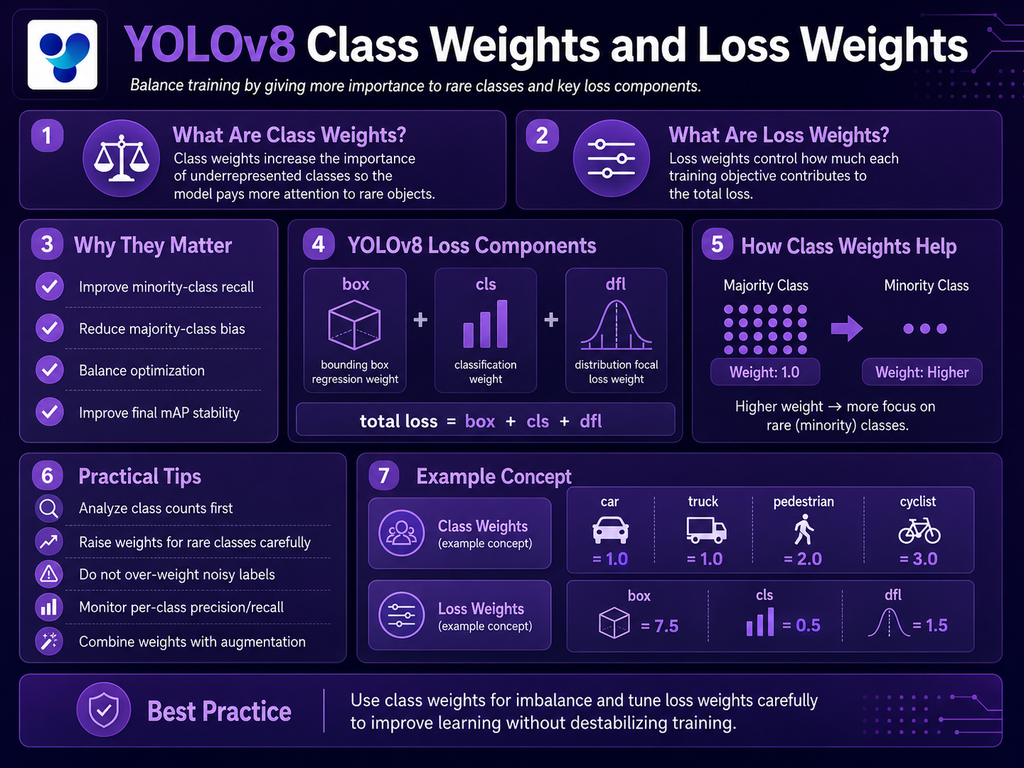
YOLOv8 Loss Functions: Box Loss, Classification Loss, and DFL Explained

YOLOv8 loss functions determine how the model measures prediction errors during training and how strongly those errors influence weight updates. For standard YOLOv8 object detection, the main reported loss components are box loss, classification loss, and Distribution Focal Loss (DFL). Current Ultralytics detection loss code explicitly maintains these three components and combines them using configurable

YOLOv8 Loss Functions: Box Loss, Classification Loss, and DFL Explained Read More »

YOLOv8 Decoupled Head: Architecture, Working, and Benefits

The YOLOv8 decoupled head is a key component of the model’s detection architecture. It separates object classification from bounding box regression so each task can be optimized independently. This design helps YOLOv8 improve detection accuracy, localization quality, and training efficiency while maintaining fast inference performance. Introduction to the YOLOv8 Decoupled Head The detection head is

YOLOv8 Decoupled Head: Architecture, Working, and Benefits Read More »

YOLOv8 Detection Head: Architecture, Working, and Features

The YOLOv8 detection head is the final stage of the object detection pipeline, where processed feature maps are converted into class predictions and bounding box coordinates. It uses a decoupled, anchor-free design that separates classification from box regression. This structure helps YOLOv8 detect objects efficiently across different scales while maintaining strong localization and classification performance.

YOLOv8 Detection Head: Architecture, Working, and Features Read More »

Scroll to Top